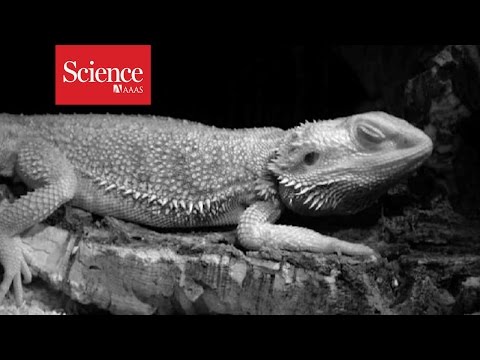
For a long time, it was assumed REM sleep was confined to mammals and birds, but it appears our lizard friends embark on nighttime adventures of their own, and that could mean animals have been dreaming for far longer than we thought.
Gilles Laurent and his colleagues at the Max Planck Institute for Brain Research were frustrated at the lack of conclusive evidence one way or another on whether or not lizards dream, so they decided to run a study on Australian dragons to see if they could come to a more a decisive answer.
As explained at Science:
The team had planned to examine how the lizards—a common pet in Germany—use visual information to chase treats. They continuously recorded the lizards’ brain activity with electrodes over several weeks. At night, the sleeping reptiles’ brains produced rhythms that could be separated into two different patterns—one at very low frequency, about 4HZ, and another, higher frequency about 20HZ, the team reports today in Science. The two frequencies alternated every 40 seconds, reminding Laurent of the regular oscillations between high-frequency REM and slow-wave sleep found in mammals and birds. “The more we looked, the more it appeared as though we were looking at bona fide REM sleep,” he says.
The lizards even displayed the eye twitching we so often observe in other animals.
Not only does this suggest dreaming goes farther back than previously believed, it also indicates REM sleep serves a similar purpose in all animals.
Comments